Do children in a managed care system receive timely vaccinations?

Not necessarily. At times rates may even dip lower than children who received private care.

Childhood immunization is a primary disease prevention strategy, although some children, especially in low-income families do not receive their vaccinations on time. Up to 40% of two year olds did not receive their immunizations at age appropriate intervals. Immunizations in some urban areas have even declined, despite many recent sporadic outbreaks. Children in a managed Medicare program have mixed records in achieving immunization rates at recommended levels and intervals.

For all immunizations in this study, Medicaid records accounted for 36% of received immunizations, state Health Department records accounted for 10% and providers documented another 24% of the required immunizations, 70% of immunizations were accounted for in this way.  There was no documentation for the remaining 30%.

Among the 5598 children that participated in this study, most were African American (73.4%) and approximately one-half were male (51%), and most were mothers 20 years old or older.

As children grew older, increasingly small percentages of them received their immunizations on time. Children who were up to date at 18 months were more likely to be served by public as compared to private providers. In addition, children with mothers over the age of 20, were more likely to have received their immunizations by 18 months, than those with mothers younger than 20. Children in the Medicaid program who were up to date at 18 months still had low numbers. African American children and those with less than 20 mothers were even less likely to be up to date at 18 months. Although some studies have found little effect of race and immunization status, the results of this study is consistent that is found with racial disparities in immunization rates. This study also proves that mothers under the age of 20 were less likely to have their child vaccinated on time. A reasoning behind this is that younger mothers have fewer resources and less knowledge and experience of the need to help children receive full immunization status.

Immunization at the appropriate age is important for conferring immunity and is a public health goal. Numerous children are incompletely protected during a period when they are most susceptible to preventable childhood diseases. Dangers from these diseases may be incorrectly perceived by parents as minimal because most diseases are rarely seen, thanks to people vaccinating their children.

Source: http://www.ncbi.nlm.nih.gov/pmc/articles/PMC2594144/
HPV underfire

HPV for preteen girls, has recently come under fire for not benefitting those who received the vaccine, one study shows that the number of lifetime cases of cervical cancer related to HPV-16 or HPV-18 would decrease by 95.4% and that the vaccination would add an average of 6.1 quality-adjusted life years per women.

The human papillomavirus (HPV) vaccine was licensed in June 2006 by the company Merck. This vaccine is known as Gardasil. Along with Merck, the recommendation of the Advisory Committee on Immunization Practices that it be routinely given to girls starting at 11-12 years of age. This set off a flurry of state-level policy making. The vaccine itself protects against four strains of HPV, the most common sexually transmitted infection in the country and a major cause of cervical cancer.

Policy’s at the state level for schools mandating this vaccination began to fly around state capitals. Bills to make this vaccine mandated were introduced in 24 states and one state governor imposed a school mandate by an executive order.

Parents were not so happy about this possibility of this vaccine being mandated for school. Why? Because it involved thinking about their daughter having sex. Most parents, I am told, do not like thinking about that. And why should they especially at 11 years old. It’s not like when the child is a baby and they can take the child in for a shot without the child caring what it is for. But a preteen girl? Yeah, she’s going to have questions, which means the parents are going to have to be prepared to answer them. Some parents even went as far as the vaccine was promoting teenage girls to have sex, because this vaccine would protect them.

Most of these proposed mandates were shut down, by either concerned parents, or the lack of evidence that was wanted to make it a mandate. Many legislators thought that there was not enough long-term safety data on the vaccine. Others argued that the purpose of immunization mandates is to prevent the spread of contagious disease, not to use school attendance as a lever to achieve other health goals.

Most private insurance companies jumped on board to cover these vaccines, so insurance was not an issue.

The biggest issue that got most mandate proposals stopped? When word got out that Merck was providing unrestricted funds to Women in Government, as national organization of female legislatures. Many of the proposed bills were introduced by these women. Therefore, the belief that mandate bills were an effort to make money for the company overshadowed whatever principled arguments might have existed.

Sources: http://www.nejm.org/doi/full/10.1056/nejmsr1003547

http://www.amcp.org/data/jmcp/pages%2012-15.pdf

Immunization History Timeline

Immunizations have a history, just like any other thing in today’s world. This offers a glimpse into how vaccinations of today came to be about.

In 1796, Edward Jenner had invented a method that could help prevent against smallpox. This method was called arm-to-arm inoculation.

By the late 1940s, scientific knowledge and research had developed enough, so that large scale vaccine production was possible. 3 vaccines were routinely recommended from then on. These vaccines protected against pertussis in 1914, diphtheria in 1926 and tetanus in 1938. These three vaccines were combined in 1948 and are given in what is known as the DTP vaccine.

In 1955, the polio vaccination was licensed for use. This vaccine had been long awaited by the American public, and celebrated Jonas Salk, the inventor of the vaccination. Before this, parents would isolate children, or send them off to family farms for the summer as the country sought to find the source to the spread of this disease.

More vaccines followed in the 1960’s. In 1963 the measles vaccine was developed. The mumps vaccine came along in 1967, followed by the rubella vaccine in 1969. These three vaccines were combined in 1971 to form the MMR vaccine.

The 1970’s saw the eradication of the small pox vaccination. It was no longer recommended for use in 1971. Research of vaccinations continued in this decade, but there were no new vaccines.

During the 1980’s we saw two new vaccinations. The vaccine against Haemophilus influenza type b was licensed for use in 1985, and was recommended on the published CDC schedule in 1989. When the scheduled was published again in 1994, it had added the hepatitis B. This vaccine came out in 1981 and was licensed in 1990, but at that time it was not recommended for the whole population only high risk sub-groups of the population. People in that group included infants of hepatitis B surface antigen-positive mothers, healthcare workers, intravenous drug users, homosexual men, and people with multiple sex partners. The recommendations changed because people who were not included in the high risk group were being affected, so it was changed to include the rest of the population of the country.

Around the turn of the century, there were even more vaccines that were developed, or were updated. These vaccines were Varicella more commonly known as chicken pox in 1996, Rotavirus in 1998-1999; and again in 2006, 2008; Hepatitis A in 2000; pneumococcal in 2001. Additional recommendations for vaccines already in existence came about and were extended to children. These vaccines were influenza in 2002, and hepatitis A in 2006.

Every year since 1995 the Centers for Disease Control and Prevention, American Academy of Pediatrics, and American Academy of Family Physicians has endorsed an annual childhood immunization schedule. As more vaccines became available, it was important that the schedule began to release annually. These annual updates include changes in information that providers need to know, such as detailed information about who should receive each vaccine, age of the receipt, number of doses, time between doses, or use of combined vaccines.

There is a considered ‘new generation’ of vaccines, and those are the ones that are recommended for adolescents. Up until this point, it only included a tetanus booster every 10 years. As of 2005 there were vaccines specifically recommended for adolescents. These vaccines were for meningococcus and human papillomavirus (HPV) as well as expanded recommendations for influenza and pertussis.

Recommendations have also changed for adults. The only booster or vaccination that adults used to receive was a tetanus booster every 10 years. In 2006 the Tdap vaccine was licensed as an improved version of the tetanus booster.  This new version includes a component to protect against pertussis. It is highly recommended for adults that would be around children too young to get this vaccine themselves. There are several other vaccinations that are recommended for adults who did not ever receive the initial dose as a child, or did not have the disease. Adult vaccines are not mandated in the way that children’s vaccines are. There is however an adult immunization schedule that is updated every year.

Source: http://www.chop.edu/service/vaccine-education-center/vaccine-schedule/history-of-vaccine-schedule.html

There is another website that is really cool, that includes a very large timeline of vaccinations and the diseases that they are for. To read that timeline, you can visit this website: http://www.immunize.org/timeline/

Ways to help improve childhood vaccination rates

Most parents of today have no experience with vaccine preventable diseases, because most fail to exist because children have been vaccinated. At first glance, it appears that vaccination rates have been met, at a second glance, this proves to be false in some local perspectives. Some physicians have taken matters into their own hands and refuse to see patients whose parents fail to vaccinate them, other encourage the parent to use the alternative vaccine schedule. Neither of these options should be satisfactory for any parent.

Parents who oppose vaccinations for religious reasons are most likely to not be swayed. That is why it is even more important for parents who are on the fence about vaccinated need to vaccinate.

There are barriers that seem to appear when seeking vaccinations, such as socioeconomic barriers. Even small copayments can prove to be a barrier for some parents. Removing barriers is the first step to improve vaccination coverage. But there is more that can be done.

The country of Australia has even gone as far as offering incentives for vaccinating children on time. Some of these incentives include, reduced insurance rates, tax rebates, or even in some cases, direct payments.

The exemption process should not be easier or cost less than receiving the actual vaccination, because cost can be considered a personal reason for exemption. It has been suggested that receiving a religion or personal-belief exemption should at least require a visit to the doctor’s office that includes counseling on the risks of the child remaining unvaccinated.

It is believed that parents will be more motivated to consider vaccinations if the doctor is truly concerned about the well-being of the patient, instead of just another office visit to pay off the fancy car or what have you. A couple bad doctors spoil it for all the rest. The more information given and time spent with the parents talking about options can make all the difference.

Source: http://www.nejm.org/doi/full/10.1056/NEJMp1113008

Immunological mechanisms of vaccinations

In other words, the category or type that each specific vaccination cocktail fits into, and how they work.

The invention of the vaccination was a turning point in the war between microbes and humans. Vaccines represent the most cost-effective life-saving device in history. We can now prevent diseases that used to wipe out large populations of people. All it takes is a visit to the local pediatrician’s office.

Vaccinations can now be classified into two broad groups.

The first group is live attenuated vaccines, these comprise weakened versions of the pathogens; thus they mimic the kind of protective immunity induced in people who survive live infection. This form of vaccination elicits strong cellular and antibody responses and often confers immunity that lasts for several decades, with even a single immunization. In other words, the vaccine in a sense causes the body to form antibodies that protect the immune system from the specific disease from the vaccine. This is not intended to make the child sick, as some people like to argue. The main goal of vaccinations is protection. Once the child has the specific antibodies in their immune system, if the child was to ever come in contact with the disease, the body would recognize it, and send out the correct destroyers or antibodies for the disease. The child would most likely never know they were exposed to it, because the vaccine kept them from feeling the effects. Immunizations that fit into this group are smallpox, yellow fever, measles, mumps, rubella and chicken pox. Live attenuated vaccines have been administered to billions of people worldwide.

The second group includes subunit vaccines, toxoid vaccines, carbohydrate vaccines, and conjugate vaccines. These types of vaccines normally include substances called adjuvants, which enhance the magnitude and quality of the immune response. Examples of toxoid vaccines are protecting against diphtheria and tetanus. Carbohydrate vaccines protect against pneumococcus. Conjugate vaccines protect against Haemophilus influenza type B or meningococcus. Despite decades of research, few adjuvants have been licensed for use around the world.

Live attenuated vaccines are the most successful vaccines that have been made and can confer lifelong memory, whereas nonliving vaccines induce protection of much shorter duration and require booster vaccination to maintain protective immunity. Attenuated vaccines serve as a type of gold standard, and by learning the mechanisms by which they induce protective immunity would be invaluable in the design of new vaccines against global pandemics and emerging infections.

http://www.nature.com/ni/journal/v12/n6/abs/ni.2039.html

Why did you vaccinate?

While compiling information together about this topic, I wanted to know why other people vaccinated their children. So I decided to conduct a survey on my personal Facebook page. The majority of the people that responded were parents or grandparents.

The question I asked them was this:  “If you have children did you vaccinate them? Why or why not?” Below are their responses:

Julia: Heck yeaa!! I did it as a child! And it kept me from catching various diseases. I think everybody should be vaccinated

Jeanette: Absolutely! Vaccines are one of the most important scientific advances in history. The studies showing autism results have been proven false. The benefits FAR outweigh the risk involved!!!!

Karen:  We did vaccinate, but not always on the schedule recommended with the younger kids. They wanted to do an accelerated schedule that had them getting up to 6 different vaccines at a time. That’s just too many at one time. We also don’t do the flu shots because the one year we did the whole family was sick all winter.

Lorrie: Definitely YES!

Diana: I would. Too many diseases are eradicated due to vaccines and could reappear in populations.

Rod: Yes, necessary, I have seen results of people having diseases before there was vaccine, I did question and get answers when new vaccines came out for my kids and even grand kids, but I seek knowledge and get answers, unlike a lot of population that get their information from uninformed crazy people.

Mariette: Yes because in order to send your kids to a public school or daycare they must be vaccinated

Carolyn: Yes, because it’s not just my kids, but all the other kids who deserve to live in the bubble of herd immunity. If I don’t vaccinate, that bubble begins to collapse and littler kids and kids with compromised immune systems can get sick. What kind of person would do that to someone?

Julie: Yes we vaccinated the kids because of school and I just think it’s a good idea for a kids immune system.

Rachel: I was always vaccinated as a child and I feel you’re better safe than sorry

Are vaccinations worth the cost?

Absolutely.

As a parent would you rather comfort a crying child for a couple hours of discomfort after receiving vaccinations, or spend days or even months trying to comfort that child in a hospital bed, or prepare to bury your child? To me, it seems simple to pick to pay the cost for the vaccination, rather than the latter. Not only would that be a huge financial burden, but an emotional burden as well. Vaccines have been shown to have provided more benefit to society than expense, and they have been estimated to save society more than $5 for each dollar spent on most routine pediatric vaccinations. If spending days in the hospital don’t scare you enough, let these numbers do the talking for themselves. These numbers come from a 2007 study. One case of measles is estimated to cost 23 more times the amount spent to vaccinate 1 child against measles. For every dollar spent on MMR more than $21 is saved in direct medical costs. For every dollar spent on diphtheria-tetanus-acellular pertussis vaccine, more than $24 is saved. For every dollar spent on the H. influenzae type b vaccine, more than $2 is saved. It was estimated that the net cost per meningococcal case adverted ranged from $0.6 million to $1.9 million and from $7million to $20 million per death prevented. The cost of many vaccinations is less than the cost needed to treat preventable diseases.

Indirect costs include considerations for cost savings resulting from the preventive elements of vaccines, such as fewer missed work days. Another benefit that is considered is that since vaccines prevent death, vaccines allow children to mature into productive members of society, rather than paying funeral costs.

Source: Supplement to Journal of Managed Care Pharmacy

http://www.amcp.org/data/jmcp/pages%2012-15.pdf

If enough people vaccinate their child, I won’t need to

False.

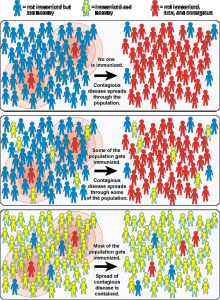
This statement could not be more wrong. Herd immunity or community immunity exists, yes. Community Immunity affects those people who can not be vaccinated, for whatever reason. People who depend on herd immunity are newborns, immunocompromised, or pregnant, these people can not physically receive vaccinations. These people are protected from contagious diseases when the spread of diseases are contained by people who can be vaccinated, receive their vaccinations, and do so on the CDC recommended timeline, thus the people create a bubble that cannot be penetrated with contagious diseases, and those that are around them that are unvaccinated are protected in this bubble as well. The principle of community immunity applies to control of a variety of contagious diseases, including influenza, measles, mumps, rotavirus, and pneumococcal disease. They are protected because the spread of contagious diseases is contained.

There are parents who depend on other parents to vaccinate their children, because for whatever reason, these people rely on using herd immunity because it is the only way that they, or their child can remain healthy. This immunity depends on people receiving their vaccinations when told to, by the medical community. The following picture represents people  cannot be vaccinated, who are protected by the number of people who were vaccinated, and when people are not vaccinated how disease can be spread.herd immunity picture thing

Source: www.vaccines.gov/basics/protection

Current California measles outbreak

To start, measles can be prevented with the Measles, Mumps and Rubella vaccination (MMR) that children receive at the age of 12 months for the first dose, and 4-6 years old for the second dose. (CDC guide) For more information on the timeline of vaccinations, check out this post: https://kjones2016.wordpress.com/2014/04/24/vaccination-timeline/

As defined by the Centers for Disease Control and Prevention, measles is a respiratory disease that causes fever, runny nose, cough and full-body rash. In extreme cases, it can cause death, and cause women to miscarry.

As of the end of March-beginning of April 2014, 49 cases of Measles have been reported in California. This is up from only 4 cases during the previous year. This outbreak is reigniting public health concern over the anti-vaccination movement. At the end of March, the California Department of Public Health urged residents to consider the startling outbreak’s implications.

This is the first year that the number of measles cases in California has passed 40 since 2000, when the disease was declared eradicated in the United States.

Sources:

http://www.cdc.gov/vaccines/schedules/hcp/child-adolescent.html

http://www.huffingtonpost.com/2014/04/04/measles-outbreak-californ_n_5092537.html